From Idea to Done: How Entrepreneurs Follow Through with Plans
Listen and subscribe on your favorite podcast app:
Apple Podcasts | Spotify | Pod.link / Pick Another App | Watch on YouTube
Disclaimer: Please note this post may contain affiliate links. This means I may receive a commission if clicked at no extra cost to you. Though the opinions remain my own
Why is it so hard figuring out how to follow through with plans?
In this episode, we’re diving into the real reason entrepreneurs struggle with execution, especially when it comes to big business changes.
Connect with me:

When You Can Decide… But Still Can’t Execute
If you’ve ever tried to make a big shift in your business and felt completely overwhelmed going from idea to action, you’re definitely not alone.
A lot of entrepreneurs don’t actually struggle with knowing what to do… they struggle with how to follow through on plans once the decision is made.
And here’s the frustrating part: clarity and decision-making are important, but they don’t change your business on their own.
➡️ Execution does.
The problem is, execution gets messy fast when there’s no structure holding it together. So if you keep starting strong, feeling motivated, and then somehow stalling halfway through… let’s talk about what’s really happening, and what actually makes follow-through feel easier instead of chaotic.
Why It’s So Hard to Follow Through on Plans
Following through isn’t just a “try harder” issue. If it were, you would’ve fixed it already. In real life, it gets complicated fast, especially when your business changes carry emotional weight, multiple steps, and limited capacity.
So before we jump into solutions, let’s talk about what’s actually making it hard to follow through with plans in the first place.
Emotional second-guessing slows everything down
Even after you’ve made a decision, your brain has a funny way of trying to renegotiate it. You sit down to work and suddenly you’re replaying the choice, wondering if it was the right move after all.
This is especially true when you’re letting go of something you worked hard on like retiring an offer or changing a direction you were once excited about. It’s not just a task change, it feels personal.
All of that emotional back-and-forth creates friction. And it’s really hard to follow through with plans when you keep reopening the decision every single time you’re supposed to execute it.

Overwhelm makes you stuck (or makes you procrastinate)
When a project feels too big, suddenly everything feels urgent. And when you’re not sure where to start, you either:
- don’t move at all
- move very slowly
- procrastinate and avoid the parts that feel the heaviest
Overwhelm doesn’t just make things uncomfortable. It makes real progress harder to access, especially when you’re trying to follow through with plans that were never broken down into manageable pieces.
You’re juggling more than you think
Most entrepreneurs aren’t just running a business. You’re managing real life too: family, health, maybe a job or side hustle, household responsibilities, client work, content creation, products, and selling. With all of that in motion, planning can fall apart quickly.
And when you don’t have a clear plan, you end up:
- making things up as you go
- fixing mistakes after the fact
- forgetting steps entirely
This is a clear capacity issue.
So yes, follow-through can feel hard. But it can also get significantly easier when you add the right structure to support you instead of relying on memory and momentum alone.
Related Post: Task vs Project: Why Your List Never Gets Done
The Real Fix for Follow-Through: Systems
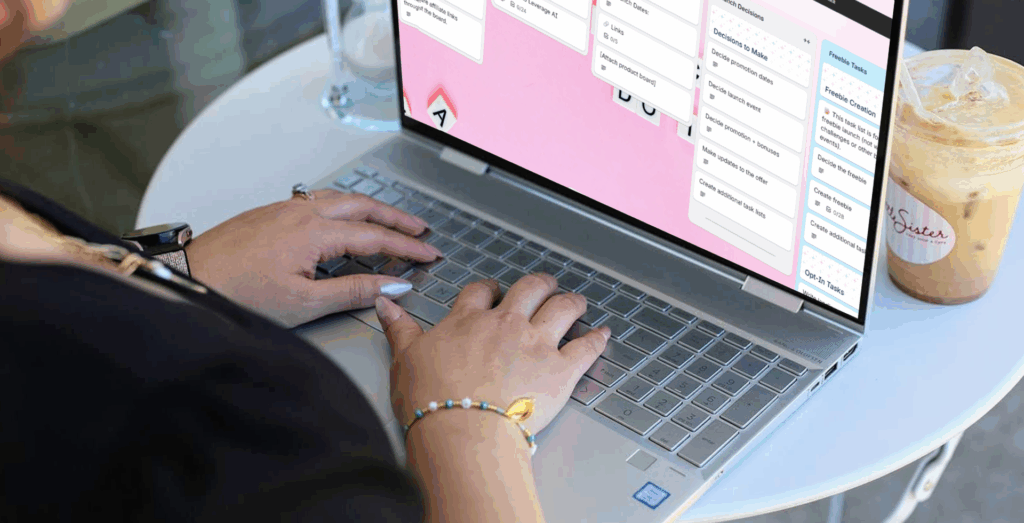
The biggest difference-maker when you’re trying to follow through with plans is a visible system. In other words: getting everything out of your head and into one centralized place.
When a project lives in your brain, you’re mentally tracking dozens of tiny tasks including the tedious ones you really don’t want to do. That’s exhaustinggggg (and it’s one of the quickest paths to overwhelm).
A visible system reduces that load because you can see the work clearly, step by step.
The Power of One Organized Space
A tool like Trello is one example (and the one I personally use for task management), but the specific platform matters less than the principle: one centralized space where you map the project from start to finish.
It’s less about the app and more about giving your brain one clear place to land.
A visible system helps you because:
- you’re not relying on memory
- your notes aren’t scattered everywhere
- you can see what “done” actually looks like
- the project becomes manageable instead intimidating
And here’s the truth most people learn the hard way: the change you think is “small” usually has way more steps than you expect.
You often don’t realize how big it is until you’re in the middle of it → forgetting steps, backtracking, and adding tasks you didn’t even know were part of the process. 😅
What This Looks Like in Real Life: A Product Retirement
One simple example of a visible system is creating a dedicated board for a product retirement.
Instead of keeping the process in your head, you give it one central home with a board might include:
- Pre-retirement tasks: final edits, setting lessons to draft, organizing course sections
- Sale prep tasks: bundling products, updating descriptions, adjusting price points, quality-checking listings
- Post-retirement cleanup: redirecting links, archiving products, cleaning up automations and tags
When you break it down into small, clear steps, you stop underestimating the work. What feels like “three quick tasks” can easily become 10–15 steps per product, especially when you’re managing multiple offers.

The Second Piece: Support
Even with a solid system in place, support is the next piece that helps you truly follow through with plans. It’s what carries you to the finish line, especially when the project is big or stretched across multiple weeks.
And support doesn’t automatically mean hiring a full team. It can look different depending on your season of life, your capacity, and what you realistically need right now.
Support option 1: Delegation
If you have support like a virtual assistant, this is where you step fully into your CEO role. You make the decisions, map the plan, build the system, and then delegate the tasks instead of carrying everything yourself.
Instructions can be written or recorded as a quick SOP-style walkthrough. It doesn’t have to be fancy. The goal is to remove bottlenecks so execution isn’t dependent on you doing every step.
And if you don’t have a VA, support can still look like hiring a one-off contractor or a tech assistant for setups you don’t want to risk breaking.
Support option 2: Accountability
Support can also be relational. An accountability partner, a business friend, or someone inside a community or membership can help you keep momentum through simple, consistent check-ins.
Sometimes just knowing someone is going to ask, “did you work on it?” is enough to stop you from postponing the project week after week. 👏🏼
Support option 3: Protected CEO time
One of the most overlooked forms of support is protected time on your calendar.
This looks like scheduling dedicated blocks to work on the project and treating them as non-negotiable. It’s a boundary you set for your future self because you’re intentionally creating space to execute, not just hoping you’ll somehow “find the time.”

Systems and Support Make Follow-Through Possible
So you see, if you’re struggling to follow through with plans, it’s usually because the structure and support aren’t fully there yet.
When your projects live in a clear system and you have the right kind of support around you, execution becomes more manageable, and you stop relying on memory and motivation alone.
If breaking projects into smaller, doable steps is where you tend to get stuck, start with my free workshop, 3 Steps to Say Goodbye to Task Overload. It will help you create a plan you can actually carry through.